Resumé Revamp 2026: Get Noticed in Under 30 Seconds

Anúncios
The 2026 resume revamp is crucial for job seekers to stand out, demanding strategic updates to capture recruiter attention in less than 30 seconds.
Hi, are you ready to transform your job search for 2026? In today’s fast-paced hiring landscape, recruiters spend mere seconds scanning resumes. That’s why a significant resume revamp 2026 is not just an option, but a necessity to make a lasting impression and secure those coveted interviews.
Anúncios
Anúncios
Understanding the 30-Second Rule in 2026
The infamous 30-second rule isn’t new, but its implications in 2026 are more profound than ever. With an overwhelming volume of applications for every open position, hiring managers and automated applicant tracking systems (ATS) alike are programmed to filter quickly. This means your resume needs to deliver its core message with immediate impact.
Gone are the days of dense paragraphs and generic job descriptions. Today, clarity, conciseness, and strategic keyword placement are paramount. Your resume must act as a compelling advertisement for your skills and experience, designed to pass initial screening and pique enough interest for a deeper dive.
The evolution of recruiter scanning habits
Recruiters often scan resumes in an ‘F’ pattern, focusing on the top, left margin, and bullet points. In 2026, this behavior is further influenced by AI-powered tools that highlight key information. Your task is to optimize your document for both human and artificial intelligence, ensuring critical data is easily digestible.
- Visual hierarchy: Use bolding, white space, and clear headings to guide the eye.
- Quantifiable achievements: Showcase impact with numbers and metrics.
- Relevance: Tailor every section to the specific job description.
Ultimately, a successful resume revamp for 2026 means creating a document that is not only visually appealing but also strategically structured to communicate your value proposition almost instantaneously. It’s about making every single word count towards getting you noticed.
Strategic Keyword Optimization for ATS
In 2026, Applicant Tracking Systems (ATS) are more sophisticated than ever, acting as the first gatekeepers in the hiring process. Without proper keyword optimization, even the most qualified candidates can be overlooked. Understanding how ATS algorithms scan and rank resumes is crucial for a successful resume revamp.
Keywords are not just buzzwords; they are the specific terms and phrases that recruiters use in job descriptions to describe required skills, experience, and qualifications. Your resume must mirror this language to be deemed a match by the ATS. This involves a meticulous analysis of target job postings and integrating those terms naturally into your document.
Identifying high-impact keywords
Start by thoroughly reviewing multiple job descriptions for roles you are targeting. Pay close attention to the skills, responsibilities, and qualifications listed. Create a master list of these keywords, noting their frequency. This will help you understand which terms are most critical for your industry and desired positions.
- Hard skills: Software proficiency, technical abilities, certifications.
- Soft skills: Communication, leadership, problem-solving, teamwork.
- Industry-specific jargon: Terms unique to your field.
Once identified, strategically weave these keywords into your summary, experience section, and skills section. Avoid keyword stuffing, which can flag your resume as spam. Instead, integrate them contextually and authentically, ensuring your resume remains readable and compelling to a human reviewer.
Crafting an Irresistible Professional Summary
The professional summary, often the first section a recruiter sees, is your elevator pitch in written form. In 2026, this section needs to be exceptionally powerful, concise, and tailored, immediately communicating your value proposition and career goals. It’s no longer just a brief overview; it’s a strategic hook designed to compel further reading.
Think of your summary as a headline that captures attention. It should highlight your most relevant skills, significant achievements, and professional aspirations in 3-5 lines. This section must be a dynamic snapshot of your career, designed to resonate instantly with the specific job you’re applying for, showcasing why you are the ideal candidate from the outset.
Key elements of a compelling summary
A strong professional summary for your 2026 resume revamp will incorporate several critical components. It should start with your professional title, followed by your most impressive qualifications and a clear statement of what you bring to the table. Quantifiable achievements are particularly effective here, as they provide concrete evidence of your capabilities.
- Your professional title: Clearly state your role or desired role.
- Core competencies: Highlight 2-3 key skills most relevant to the job.
- Quantifiable achievements: Use numbers to demonstrate impact.
- Career objective (optional): Briefly state your immediate career goal.
Ensure that your summary is not a generic statement but a customized message that aligns perfectly with the job description. This targeted approach significantly increases the chances of your resume passing the initial scan and captivating the recruiter’s interest, prompting them to explore the rest of your qualifications.
Highlighting Achievements with Quantifiable Results
One of the most impactful changes in a 2026 resume revamp is the shift from listing responsibilities to showcasing achievements with quantifiable results. Recruiters aren’t just interested in what you did; they want to know the impact you made. Numbers speak louder than words and provide concrete evidence of your value.
Every bullet point under your experience section should be reframed to highlight an accomplishment rather than just a task. This requires a shift in thinking: instead of saying, ‘managed social media accounts,’ consider ‘Grew social media engagement by 40% over six months, resulting in a 15% increase in lead generation.’ This demonstrates direct contribution and measurable success.
The STAR method for achievement-based bullets
The STAR method (Situation, Task, Action, Result) is an excellent framework for structuring your achievement-oriented bullet points. While you won’t write out the full STAR story on your resume, you’ll use its principles to distill the most critical information into a concise, impactful statement.
- Situation: Briefly set the context of your work.
- Task: Describe the challenge or goal you faced.
- Action: Detail the steps you took to address the task.
- Result: Quantify the positive outcome of your actions.
By consistently applying this approach, your resume will transform into a powerful document that not only outlines your experience but also vividly illustrates your contributions and the tangible benefits you brought to previous roles. This makes it far more compelling and memorable for any recruiter.
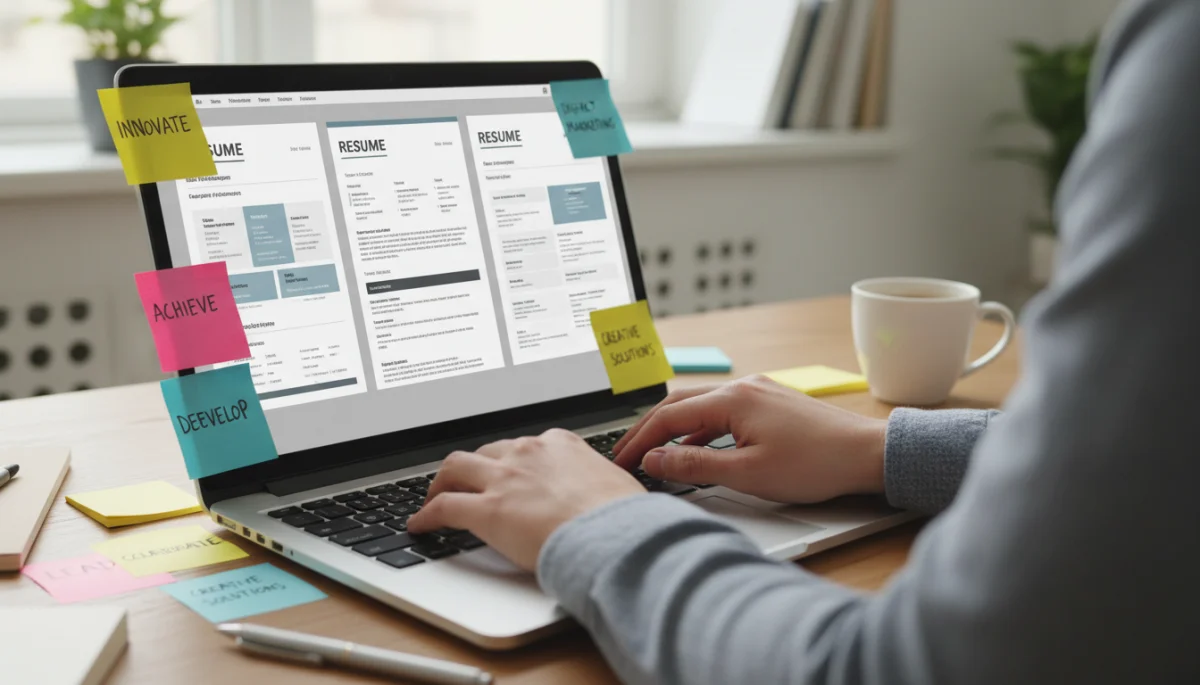
Modern Design and Formatting Principles
The visual presentation of your resume in 2026 plays a critical role in capturing attention within those crucial first 30 seconds. A clean, modern, and easy-to-read design not only enhances readability but also conveys professionalism and attention to detail. This isn’t about flashy graphics, but rather strategic use of layout, typography, and white space.
Avoid overly elaborate templates or excessive colors that can distract or make your resume difficult for ATS to parse. Instead, focus on a minimalist aesthetic that prioritizes clarity and organization. The goal is to make it effortless for recruiters to find the information they need, quickly and efficiently.
Key design considerations for 2026
When undertaking your resume revamp for 2026, pay close attention to several design elements. Choose a clean, professional font that is easy to read both on screen and in print. Sans-serif fonts like Arial, Calibri, or Lato are generally safe bets. Ensure consistent formatting throughout, including heading sizes, bullet point styles, and spacing.
- Readability: Use clear fonts and appropriate font sizes (10-12pt for body, 14-16pt for headings).
- White space: Ample margins and spacing prevent a cluttered look.
- Consistency: Maintain uniform formatting across all sections.
- File format: Always submit in PDF unless otherwise specified, to preserve formatting.
A well-designed resume is a reflection of your organizational skills and attention to detail. It demonstrates that you understand the importance of clear communication and respect the recruiter’s time. By adhering to modern design principles, your resume will stand out for all the right reasons.
Tailoring Your Resume for Each Application
In 2026, a generic, one-size-fits-all resume is a direct path to the rejection pile. The most effective strategy for a successful resume revamp is to tailor your document for every single job application. This personalized approach demonstrates genuine interest and directly addresses the specific needs outlined in the job description, significantly increasing your chances of success.
Tailoring goes beyond just swapping out a few keywords. It involves carefully analyzing the job posting, understanding the company culture, and then strategically adjusting your professional summary, bullet points, and skills section to align perfectly with what the employer is seeking. This shows you’ve done your homework and are genuinely invested in the opportunity.
Steps to effective resume tailoring
Begin by meticulously deconstructing the job description. Identify the core responsibilities, required skills, and preferred qualifications. Pay attention to the language used, as these are the keywords the ATS and hiring manager will be looking for. Then, adapt your resume to reflect these elements prominently.
- Analyze the job description: Highlight key requirements and keywords.
- Customize your summary: Rephrase to align with the company’s mission or job’s focus.
- Select relevant achievements: Choose bullet points that directly showcase skills mentioned in the posting.
- Update skills section: Prioritize skills that are explicitly requested.
This iterative process of customization might seem time-consuming, but it is an investment that yields significant returns. A tailored resume not only performs better with ATS but also makes a stronger impression on human recruiters, demonstrating your commitment and suitability for the role.
Integrating Soft Skills and Personal Branding
While hard skills and quantifiable achievements remain crucial, the 2026 job market places an increasing emphasis on soft skills and personal branding. Recruiters are looking for candidates who not only possess the technical abilities but also fit into the company culture and demonstrate strong interpersonal capabilities. A comprehensive resume revamp must reflect this shift.
Your resume is an extension of your personal brand. It should subtly communicate not just what you can do, but who you are as a professional. This involves thoughtfully integrating soft skills throughout your experience and summary sections, and ensuring your overall document reflects a cohesive and positive professional image.
Showcasing critical soft skills
Instead of merely listing soft skills, demonstrate them through examples. For instance, rather than stating ‘good communicator,’ describe an achievement where your communication skills were pivotal to a project’s success. Use action verbs that imply soft skills, such as ‘collaborated,’ ‘mentored,’ ‘negotiated,’ or ‘innovated.’
- Communication: Highlight presentations, client interactions, or team collaboration.
- Leadership: Detail projects led, teams managed, or initiatives driven.
- Problem-solving: Describe challenges overcome and solutions implemented.
- Adaptability: Showcase instances of quickly learning new tools or processes.
Beyond skills, consider how your resume’s aesthetic and content contribute to your personal brand. Is it professional, innovative, results-oriented? Ensure consistency across your resume, LinkedIn profile, and other professional online presences. This holistic approach to personal branding will make your resume memorable and compelling.
| Key Aspect | Brief Description |
|---|---|
| 30-Second Rule | Optimize for quick scans by recruiters and ATS with clear, concise content. |
| ATS Optimization | Integrate relevant keywords from job descriptions to pass automated screenings. |
| Quantifiable Achievements | Replace responsibilities with measurable accomplishments using numbers and metrics. |
| Tailoring & Branding | Customize for each application and integrate soft skills to reflect personal brand. |
Frequently Asked Questions About Your 2026 Resume
It’s advisable to review and update your resume at least annually, or whenever you gain significant new skills, complete a major project, or change roles. For 2026, a comprehensive revamp is recommended to align with current ATS and recruiter expectations.
For entry-level to mid-career professionals, a one-page resume remains ideal for quick readability. Experienced professionals with extensive careers might extend to two pages, but every section must be highly relevant and impactful to justify the length.
In the U.S., it’s generally recommended not to include a photo on your resume due to potential bias issues. Focus on your qualifications and achievements. Some international markets may have different customs, so always research local norms.
Action verbs are incredibly important as they make your achievements more dynamic and impactful. They help convey your contributions clearly and concisely, making your resume more engaging for both human recruiters and ATS algorithms that look for strong indicators of performance.
Yes, AI tools can be beneficial for identifying keywords, suggesting improvements, and even checking grammar and readability. However, they should be used as aids, not replacements for human judgment, ensuring your resume remains personalized and authentic to your experience.
Conclusion
The job market of 2026 demands a proactive and strategic approach to your resume. A thorough resume revamp is not merely about updating dates; it’s about reimagining your professional narrative to capture attention in an ultra-competitive landscape. By focusing on immediate impact, ATS optimization, quantifiable achievements, modern design, and personalized tailoring, you empower your resume to work harder for you. Embrace these changes, and you’ll be well-positioned to secure interviews and advance your career goals, making every second of a recruiter’s attention count.
